From site selection and preconstruction to commissioning and operations, specialized teams turn AI infrastructure from an idea into a working facility.
When most people picture the workforce behind artificial intelligence, they think about machine learning engineers, AI researchers, and software developers.
Those professionals are central to the story. But they are not the whole story.
Long before an AI model can run, someone has to find the right land, secure enough power, design the facility, lead the build, test every system, and prepare the site for years of continuous operation. Those responsibilities belong to a large and highly specialized workforce that rarely enters the public conversation about AI.
The Jobs Behind the Data Center Buildout
Blue Signal CEO Matt Walsh joined CNBC’s Squawk Box to discuss the thousands of jobs created as data centers move from development and construction to long-term operation.
The jobs Matt describes are tied to infrastructure being developed at an enormous scale. Lawrence Berkeley National Laboratory estimates that data centers could account for 11.8% of total U.S. electricity use by 2030. That level of demand does not appear when a server is switched on. It is planned for years in advance and carried through a long chain of development, construction, and operational decisions.
In Blue Signal’s recruiting work across the data center sector, we see large-scale facilities take roughly three to five years to move from site selection to full operation. They are not built by one permanent team. They are passed from one group of specialists to the next, and every handoff creates a different hiring challenge.
The Data Center Workforce Starts Years Before Opening Day
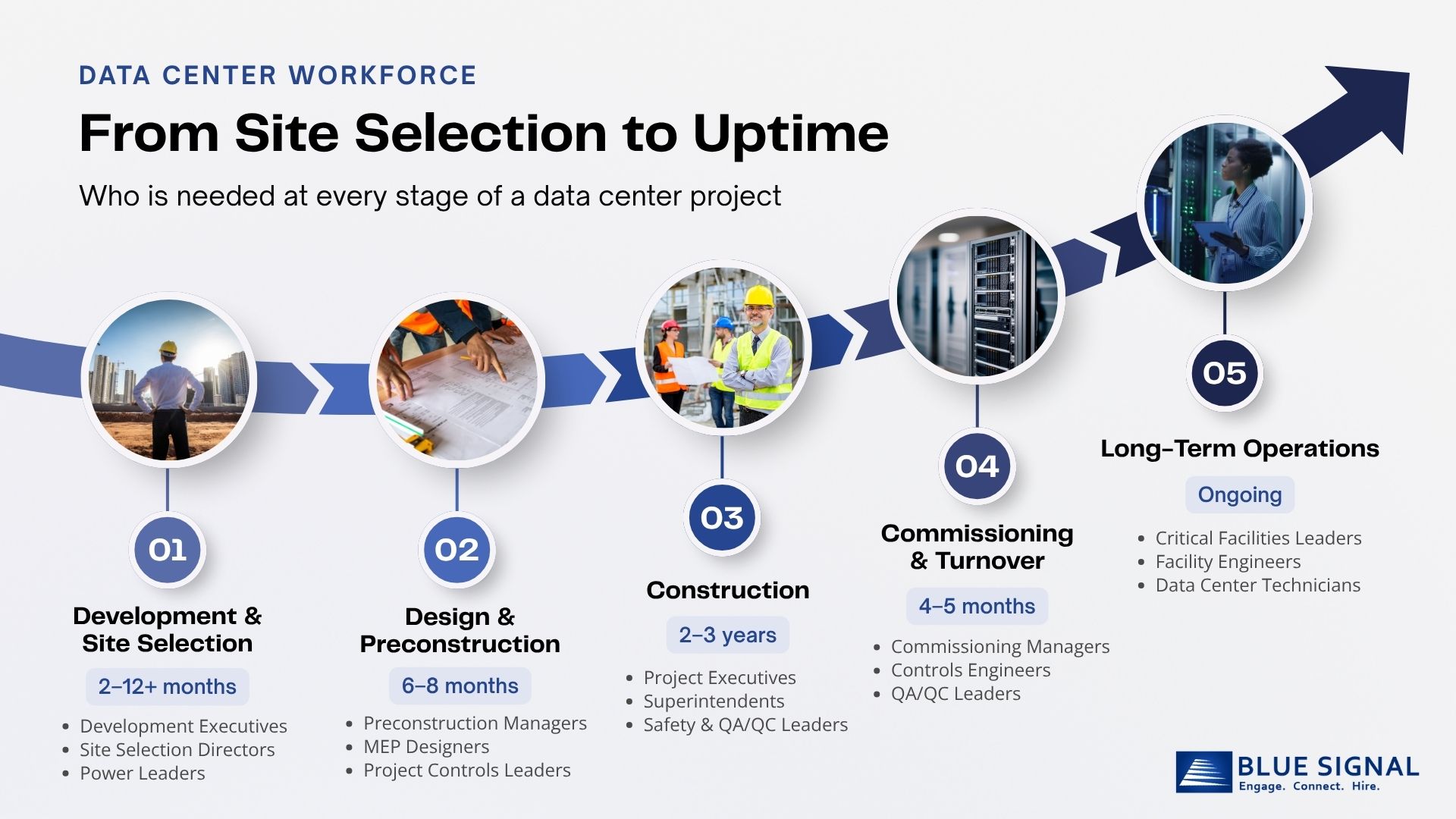
A data center may look like one construction project from the outside. Internally, it is a series of distinct stages:
- Development and site selection
- Design and preconstruction
- Construction
- Commissioning and turnover
- Long-term operations
The workforce grows, contracts, and changes throughout that lifecycle. Developers often maintain relatively lean internal teams while general contractors, engineering firms, subcontractors, commissioning partners, and facility management providers carry out much of the work.
That structure matters for hiring. A company does not simply need “data center talent.” It needs the right experience at the right point in the project, often months before the need becomes visible on-site.
Five Workforce Handoffs Behind One Data Center
1. Development Begins with Land and Power
Every project begins with two basic questions: Is there a viable place to build, and can the developer secure enough power?
Site selection involves far more than finding available land. Development teams must assess power and water availability, grid and infrastructure capacity, permitting requirements, and how a proposed facility fits within the surrounding community. That requires early coordination with utilities, regulators, and local stakeholders. Experienced leaders help companies evaluate these factors before major commitments are made.
Evaluating these factors can require Chief Development Officers, Site Selection Directors, development managers, power and energy executives, utility coordination leaders, and specialists who understand permitting, financing, and project feasibility.
This early stage can move quickly when land, power, and capital are already aligned. In other cases, it can take a year or longer before construction planning truly begins. The timeline depends on the developer, investors, utility coordination, engineering requirements, and the conditions attached to the site.
These are some of the earliest hires in the lifecycle, but they can also be among the most consequential. A strong development leader does more than evaluate a parcel of land. That person helps determine whether a project can move from a promising idea to an executable plan.
2. Preconstruction Turns a Site into a Buildable Plan
Once a project is viable, the focus shifts to design, estimating, procurement, scheduling, and construction planning. For many large projects, this phase lasts approximately six to eight months, although the timeline varies.
Preconstruction Managers, estimating leaders, MEP design professionals, procurement specialists, and project controls leaders work through the details that will shape the build. They evaluate costs, equipment lead times, contractor requirements, constructability, and the sequence of work.
Recruiting is already active during this stage. Companies may be building preconstruction teams while financing and engineering are still underway, and some of these professionals support several projects at once rather than remaining dedicated to one site.
This is also where hiring plans can begin to fall behind. If a company waits until it is ready to break ground, it may already be late to recruit the leaders responsible for making the project buildable.
3. Construction Creates the Largest Workforce Expansion
Construction is when the scale of the workforce becomes most visible.
Large campuses can involve thousands of workers over the life of the build, with much of that labor supplied through general contractors, subcontractors, engineering firms, and specialty partners. The core leadership group may include Project Executives, Project Managers, superintendents, electrical and mechanical engineers, safety leaders, and QA/QC professionals.
A large-scale data center typically requires two to three years of construction. During that time, senior leaders may travel extensively or remain assigned to the same site until the work is complete. When one project ends, many move directly to the next campus.
Demand for this experience is landing inside an already competitive construction labor market. The U.S. Bureau of Labor Statistics identified AI data center development as one factor driving projected construction employment growth. It projected 6.6% growth from 2023 to 2033 for both electrical contractors and power and communication line construction, the fastest rates among the construction industries it examined.
The volume is only part of the challenge. These facilities rely on complex electrical and mechanical systems, strict quality standards, and aggressive schedules. Companies need leaders who can keep all three in balance.
4. Commissioning Is Its Own Risk-Critical Stage
A facility can be physically complete without being ready to operate.
That distinction is the reason commissioning deserves to be treated as its own workforce stage, not as the final item on a construction checklist. Commissioning teams test and verify the systems that keep the facility powered, cooled, controlled, and protected. They confirm that equipment performs as designed and that interconnected systems respond correctly before customer workloads go live.
Commissioning Directors, Commissioning Managers, controls engineers, electrical and mechanical specialists, and QA/QC leaders may spend another four to five months guiding the facility through testing and turnover.
This work carries little room for error. The value of experienced commissioning talent is not simply technical knowledge. It is the ability to identify risk before that risk becomes an operational problem.
5. Operations Takes Over After Construction Leaves
Once commissioning is complete, the workforce changes again.
Construction and commissioning teams generally move on. Long-term responsibility shifts to the owner, operator, or facility management partner, which builds a team around uptime, safety, maintenance, and performance.
That team may include Critical Facilities Operations Leaders, Operations Managers, Facility Engineers, Data Center Technicians, and maintenance leaders. Some owner-operators employ these professionals directly. Others work with outside facility management providers.
The jobs may be more permanent than project-based construction roles, but they are not easier to fill. In its 2025 Global Data Center Survey, Uptime Institute found that nearly two-thirds of operators reported difficulty finding qualified candidates, retaining staff, or both.
By this stage, a hiring gap is no longer an obstacle to a future construction milestone. It can affect the team responsible for keeping a live facility running.
The Hiring Challenge Is Timing, Not Just Volume
The demand for data center talent is real, but headcount alone does not explain the difficulty.
The harder problem is sequencing. Companies need different capabilities at different times, and a delayed hire in one stage can create problems in the next. A late preconstruction hire can affect planning. A gap in construction leadership can put pressure on safety, quality, and schedule. An operations team hired too close to turnover may have limited time to learn the facility it will inherit.
Three hiring mistakes we see repeatedly
- Recruitment begins only when the project is ready to break ground.
- Construction and operations are treated as one continuous workforce.
- Direct data center experience is required for every position, even when adjacent experience may transfer.
A better workforce plan follows project milestones. It identifies which leaders need to arrive early, which roles can be staffed through partners, which skills can transfer from other sectors, and which positions require proven data center experience.
That approach gives companies more time to reach a limited talent pool. It also makes hiring more precise. The goal is not to build the largest team as early as possible. It is to have the right people in place before each handoff occurs.
Where Transferable Experience Works, and Where It Does Not
As hiring demand grows, employers are becoming more open to professionals from semiconductor facilities, advanced manufacturing, healthcare construction, power and utility infrastructure, and other complex industrial environments.
That shift makes sense. Candidates from these sectors may already understand large electrical and mechanical systems, project controls, safety requirements, commissioning, and construction in highly regulated settings.
Still, broadening the talent pool does not mean lowering the standard. It means separating skills that can transfer from experience that must already exist.
For many project management, engineering, and field leadership positions, strong mission-critical or industrial experience can provide a credible path into the sector. At the senior level, the line is often firmer. Companies remain highly selective when hiring executives and leaders responsible for construction strategy, commissioning, QA/QC, safety, and operational readiness.
Those leaders are expected to make decisions under significant cost and schedule pressure. In many cases, there is no substitute for having already worked through the demands of a large data center project.
For Companies Entering the Market, Leadership Comes First
The same distinction matters for companies pursuing their first data center project.
Blue Signal has worked with firms that brought substantial construction, development, or infrastructure experience but had not yet established data center credentials. They did not need to begin by hiring an enormous team. They needed a small number of experienced leaders who understood the market, the client’s expectations, and the talent required to deliver the work.
Those early leadership hires helped the companies build credible teams, make better workforce decisions, and compete for opportunities in the sector.
One hire cannot guarantee a contract or remove every barrier to entry. But the right leader can give a company something it cannot gain quickly from a playbook: firsthand understanding of how data center projects are planned, staffed, and executed.
AI’s Future Depends on People Who May Never Touch the Model
The future of AI will be shaped by researchers, engineers, and software developers. It will also depend on the people who secure the land and power, plan the project, lead the build, test every system, and keep the facility running after the construction crews leave.
They may never train a model or write a line of code. Their work still determines how much AI infrastructure can move from concept to operation.
For employers, the lesson is straightforward. Data center hiring cannot begin at the moment a position becomes urgent. The companies best prepared for this buildout will understand the workforce handoffs ahead of them and start hiring for each one early.
Blue Signal helps data center developers, contractors, operators, and infrastructure companies recruit the leaders and specialized professionals behind every stage of the project lifecycle. Connect with our data center recruiting team to discuss your upcoming hiring needs.
Meet the Data Center Practice Leaders Behind These Insights



Frequently Asked Questions About Data Center Workforce Planning
How long does it take to build and staff a data center?
A large-scale data center may take approximately three to five years to move from site selection to full operation. Development, design, construction, commissioning, and operations staffing often overlap, so the total timeline is not simply the sum of each stage. Project scope, financing, permitting, utility coordination, and talent availability can all affect timing.
What roles are needed throughout the data center lifecycle?
Workforce needs change with each stage. Development may require development executives, site selection directors, and power infrastructure leaders; design and preconstruction rely on preconstruction managers, MEP professionals, and project controls leaders; construction adds project executives, superintendents, and safety and QA/QC leaders. Commissioning managers and controls engineers support turnover, while critical facilities leaders, facility engineers, and data center technicians keep the completed facility operating.
When should companies begin recruiting for a new data center project?
Recruiting should be planned around project milestones and begin before each workforce becomes urgent. Construction hiring can start during preconstruction, commissioning talent should be identified before the build is complete, and key operations employees should be in place ahead of turnover. Starting early gives employers more time to secure specialized talent and support smoother handoffs between teams.
Which industries offer transferable experience for data center roles?
Professionals from semiconductor facilities, advanced manufacturing, healthcare construction, and power and utilities may bring relevant experience to data center projects. Transferable strengths can include complex MEP systems, project controls, safety, commissioning, and regulated construction. Employers should evaluate the requirements of each position instead of requiring direct data center experience for every role.
Which positions typically require direct data center experience?
Direct experience is often most important for senior positions responsible for critical systems, uptime, commissioning, turnover, or facility operations. Critical facilities leaders, senior commissioning professionals, and certain controls or operations leaders may need a proven record in live data center environments. The exact requirement depends on the facility, risk level, and scope of the role.
Partner with us for your next hire.
Tell us about your hiring need.
By submitting this form, you consent to receive communications from Blue Signal via phone, email, and conversational SMS. Message frequency varies. Msg & data rates may apply. Reply STOP to opt out or HELP for assistance. Visit Privacy Policy and Terms of Service.
